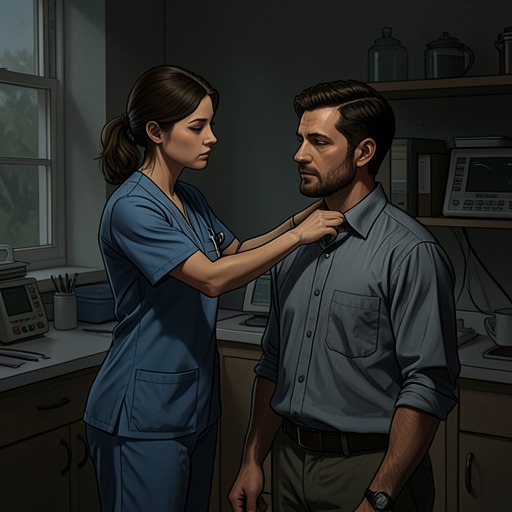
Ivy Bolton
Lady Chatterley's LoverIvy Bolton is a Tevershall nurse whose hard-won independence and intimate knowledge of the village make her much more than a caregiver at Wragby Hall. Hired to look after Clifford Chatterley, she enters a household divided by class and marital estrangement, then becomes his confidante and a trusted witness to Connie Chatterley’s relationship with Oliver Mellors. Her care binds her to the household even as her own experience of loss and working-class life gives her a perspective distinct from its owners.
Identity and Background
When Clifford needs a nurse, Ivy Bolton is recommended as the Tevershall parish nurse, then preparing to leave district work for private nursing. She is forty-seven when she arrives at Wragby, although Connie notices how young she seems. The family already has a connection with her: she once nursed Clifford through scarlet fever, easing his reluctance to entrust himself to a stranger. To the sisters who visit her, Ivy is attentive and polite, self-assured from years of caring for sick miners, and accustomed to exercising authority in her own sphere. She is respected in the village, where nursing has made her a familiar figure across the boundaries of class.
Her independence was built after the death of her husband, Ted Bolton, killed in a pit explosion at the age of twenty-eight. He left her with two young children, one still a baby. At the inquiry, the mine owners’ side represented Ted as having panicked and disobeyed orders, making the disaster seem his fault. Ivy maintained that he had been steady and fearless. The compensation was limited to three hundred pounds, and the family was not allowed to receive it as a lump sum to help her start a shop. Instead, she had to collect thirty shillings each week, spending almost four years going to the offices and waiting for payment. The money was framed as though it were a gift rather than compensation due to her husband’s death, while the decision to withhold it rested on an assumption that she might squander it.
With her mother-in-law helping to care for the children, Ivy travelled to Sheffield for ambulance classes and later qualified as a nurse. She worked as an assistant at the small hospital in Uthwaite before the Tevershall Colliery Company, particularly Sir Geoffrey Chatterley, supported her appointment as parish nurse. She acknowledges that the company treated her well professionally, but never forgets its attempt to blame Ted. That contradiction remains central to her account: she can recognize the help she received without accepting the injustice done to her husband’s memory.
Care at Wragby Hall
Ivy comes to Wragby Hall with two trunks after arranging to leave her parish duties. She helps Clifford to bed at night, sleeps across the passage, and answers when he calls. In the morning she assists him again, eventually taking over his personal care, including shaving him. Her skill is practical and attentive; she learns how to manage his needs and sees that, beneath the difference in rank, his dependence resembles that of the miners she has nursed.
The change has consequences for Clifford and Connie. Clifford never forgives Connie for giving up her personal care of him to a hired nurse, believing that the handover has destroyed the most intimate part of their marriage. Connie, by contrast, welcomes the time Ivy’s work gives her. Their different responses expose how little the same arrangement means to each of them: for Clifford it signifies the loss of a private bond, while for Connie it releases her from a form of closeness she no longer wants. Ivy does not set out to displace Connie, but her daily care makes her an increasingly important presence in Clifford’s life.
Village Knowledge and the Affair
The household’s conversations also give Ivy another kind of influence. She talks at length about Tevershall and the people she has nursed and known. Clifford listens for material, and Connie recognizes in his apparent literary talent a sharp aptitude for gathering personal stories and gossip. Ivy’s knowledge is not merely a store of amusing incidents: it comes from sustained contact with the private difficulties of village life. Connie is fascinated by the talk, but also uneasy about listening to other people’s most intimate troubles as entertainment. Through Ivy, the novel brings the unseen lives of the village into Wragby’s drawing rooms while raising questions about the difference between curiosity and sympathy.
One morning, as daylight returns, Ivy sees Oliver Mellors standing outside the house with his dog and recognizes him as Connie’s lover. The realization is especially charged because she remembers Mellors as a sixteen-year-old boy who helped her with anatomy while she was studying nursing. She recalls his intelligence and his scholarship at Sheffield Grammar School, and reflects on how he later worked as a blacksmith shoeing horses. Her recognition joins an earlier acquaintance to the secret now unfolding at Wragby; she becomes someone who knows the truth without being told by either of the people involved.
While Connie is away, Ivy’s correspondence helps keep that confidence alive. A letter from Ivy reports that Clifford is working hard and hopes Connie will return, but also describes Mellors’s wife coming back to his cottage and demanding that he resume their marriage. Mellors refuses, leaves the cottage, and goes to his mother’s home. Connie responds by writing to Ivy, enclosing a note for Mellors and asking her to pass it on. She tells him not to be discouraged by the trouble his wife is making and says she expects to return soon. Ivy therefore serves as a discreet link between the separated lovers, carrying a message that confirms Connie’s intention to stand by him.
Loyalty, Intimacy, and Departure
When Connie finally tells Ivy that she cares for Mellors and asks her to keep the matter secret, Ivy promises discretion. She says that she will remain faithful to Clifford and to Connie because she can see that both are right in their own ways. Her answer does not require her to deny the conflict between them or choose one person as wholly deserving of loyalty. She accepts that her obligations have become divided, yet does not betray either confidence. Connie also asks her to let her know if Clifford might ever be willing to grant a divorce, since she wants to marry the man she loves.
Ivy’s relationship with Clifford deepens after Connie’s departure. When Clifford is overcome by his sense of betrayal, Ivy begins to weep herself, drawing on her own old grief. His tears follow, and she comforts him rather than trying to rouse his pride. Their attachment develops into an emotionally and physically intimate, childlike pattern in which Clifford seeks her affection and Ivy feels both drawn to and troubled by the role she occupies. The narrative presents her as at once moved by his dependence and uneasy about it, not as a simple replacement for Connie but as a woman caught in a complicated arrangement of care, power, and feeling.
That private dependence coexists with Clifford’s renewed business energy. He becomes more decisive and shrewd in his colliery affairs, and Ivy takes pride in his progress, believing that she has helped him move forward. The contrast is striking: the man who relies on her for comfort can be hard and effective in business. Ivy’s position therefore reaches beyond nursing. She helps sustain Clifford’s private life, listens to the village stories he turns into material, and remains at Wragby as Connie prepares to leave. When Connie goes north with Hilda, Ivy keeps her confidence; Mellors, meanwhile, takes farm work in preparation for the possibility of building a life with Connie. Ivy’s loyalty cannot resolve the household’s divisions, but it makes her a crucial witness to the fragile ties that persist across them.